The treaty that keeps a continent unowned, and shapes every voyage
Who owns Antarctica? The treaty, the rules, and no hotels
Discover AntarcticaAsk most people who owns Antarctica and you’ll likely get a confident answer that turns out to be wrong, or a shrug of the shoulders. Some assume it belongs to whichever country is nearest, or to the one with the biggest flag planted on the ice. Others picture a kind of shared park run by the United Nations. A few are certain you need a visa to go, as though there were a border post somewhere on the Peninsula stamping passports in the snow.
None of that is quite true. The honest answer is stranger and, once you understand it, far more interesting: no one owns Antarctica. There is no government, no capital, and no such thing as an Antarctic citizen. The continent is held in a state of deliberate suspension by an agreement now more than sixty years old, and that same agreement shapes almost everything about how you can visit. It is why there are no hotels, and why the ships are small. Once you grasp it, the place looks different before your ship has even left the dock.
An agreement to disagree, permanently
The document at the centre of all this is the Antarctic Treaty, signed in Washington on 1 December 1959 by twelve countries, Australia among them. It came into force on 23 June 1961. Its purpose was elegantly simple for its era, which was the depth of the Cold War: it set the entire continent aside for peace and science, reserved it for peaceful purposes only, and banned nuclear explosions and the dumping of radioactive waste. It applies to everything south of 60 degrees South latitude.
That much is straightforward. The clever part is how it handles the question of ownership, because seven nations had, by 1959, already made formal territorial claims. Here they are:
- Argentina
- Australia
- Chile
- France
- New Zealand
- Norway
- The United Kingdom
Some of these claims overlap, which in ordinary international life is the sort of thing that leads to a great deal of trouble. The Treaty’s solution was not to settle the argument but to freeze it. Under Article IV, no claim is recognised and none is rejected. No new claims may be made. Nothing a country does while the Treaty is in force counts either for or against its claim. In effect, everyone agreed to disagree, and to keep disagreeing indefinitely, so that the science and the peace could carry on regardless. Australia, for the record, claims the largest sector of any nation, the Australian Antarctic Territory, though under the Treaty that claim confers no ownership you would recognise as such.
Decisions today are made by consensus among the Consultative Parties, the countries with an active research presence, and the Treaty has grown to more than fifty parties in all. Running a continent by consensus is slow, and often maddening, and it is also the reason the system has held.
The rule that keeps the mines shut
If the Treaty froze the politics, a later agreement settled the environment. The Protocol on Environmental Protection, usually called the Madrid Protocol, was adopted in 1991 and came into force in 1998. It designates Antarctica as a natural reserve devoted to peace and science. It bans all mineral-resource activity apart from scientific research, with no expiry date attached, and it requires environmental assessment before anything is done and permits before anyone interferes with wildlife. The only thing anyone may carry off the continent is what they learn there.
This is the backdrop to the thing you actually notice as a visitor, which is that Antarctica has no native population, no permanent residents, and nowhere to stay. The people there are rotating staff at national research stations, and they leave again. There are no commercial hotels. There is no reason to build one, and every reason not to. Visitors sleep on ships or, in a handful of cases, at a few seasonal camps. You don’t check in to Antarctica. You visit, and you are expected to leave it as you found it.
Why the ships are small
Here is where the governance stops being abstract and starts deciding the shape of your trip. Tourism is regulated largely by IAATO, the International Association of Antarctica Tour Operators, an industry body founded in 1991. It is not a government, but it has been an invited expert at Antarctic Treaty meetings since 1994, and its members, well over a hundred of them, agree to a shared set of rules. Those rules explain the whole design of polar travel.
No more than 100 passengers may be ashore from a single vessel at any one time. A ship carrying more than 500 passengers may not land its passengers at all. Only one ship may visit a site at a time. There is a guiding ratio of roughly one guide to every twenty passengers, and there are minimum distances you must keep from wildlife.
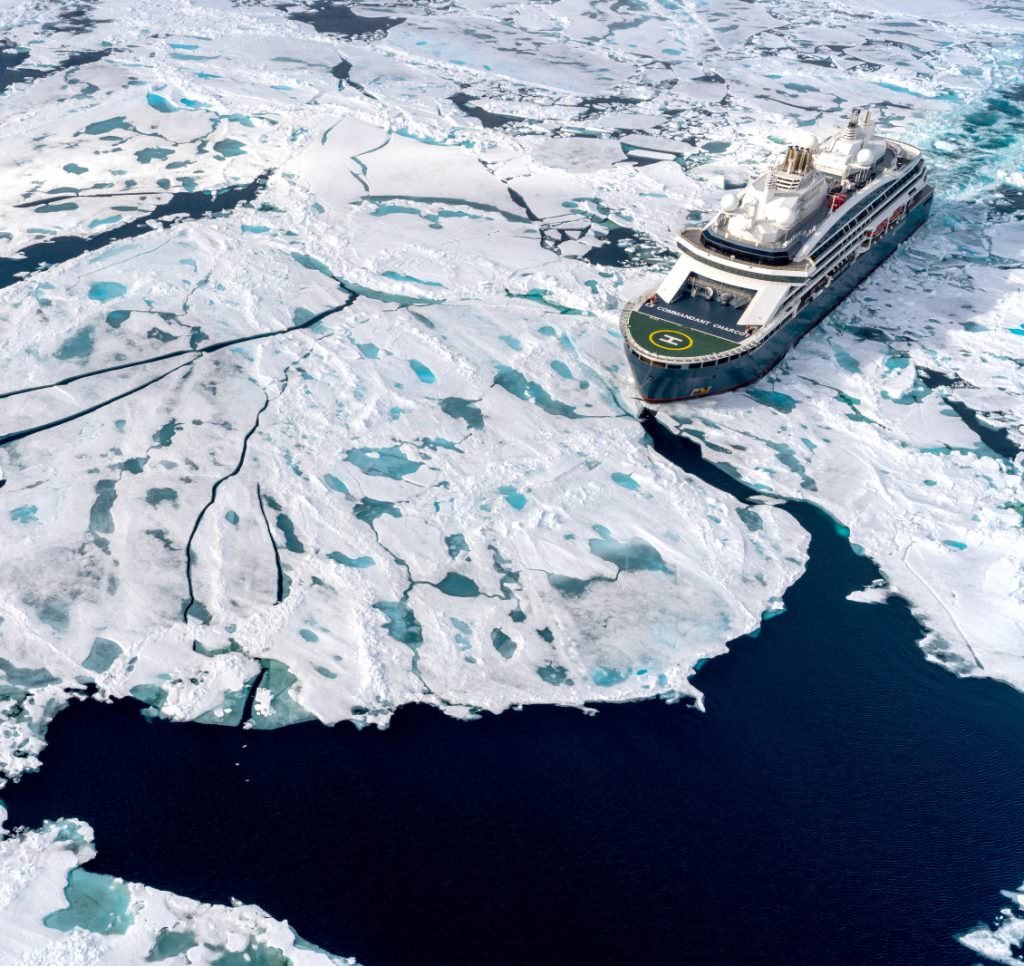
Read those limits again and the logic of small-ship expedition travel falls into place. A ship carrying fewer than a hundred guests can put everyone ashore at once, together and unhurried, with time to stand still and watch. A larger ship must rotate its passengers ashore in groups, which means waiting your turn and landing to a timetable, and the largest ships, the ones built for warm-water cruising, cannot land their passengers on the continent at all. They can only sail past.
So the small ship is no compromise. It is the only kind of vessel the rules allow to set everyone ashore together, and the same rules that keep Antarctica ungoverned and unspoiled are what keep its landings small and quiet.
None of which guarantees a landing. Whether you get ashore on any given morning depends on the weather and the ice, and those answer to no treaty and no timetable.
Well over 100,000 people travelled to Antarctica in the 2024 to 2025 season, the great majority of them to the Peninsula. Not one of them carried an Antarctic visa, because there is no such thing. Whatever stamps your passport collects on the long flight south, none of them will be Antarctic. The expedition itself is authorised instead by a Treaty nation’s competent authority. Australian operators, for instance, answer to the Australian Antarctic Division under a 1980 Act. You go as a guest the system has collectively agreed to admit, rather than a citizen crossing any border.
Picture it, then. A morning near 65 degrees South. Your ship lies quiet in a bay no larger ship can enter. There is no port, no pier, no town beyond the shore, no flag that means what a flag usually means. There is only the ice, and the small boat waiting to take you the last short distance to a continent that belongs to no one and, for a few hours, to you.