The tiny animal that holds up the whole food web
Krill: the small animal that runs the Southern Ocean
Discover AntarcticaSix centimetres. That is the full adult length of the animal on which most of Antarctic life depends. Antarctic krill, Euphausia superba, is a crustacean a little longer than a paperclip and weighing something over a gram, and yet the whales, seals, penguins, seabirds, fish and squid that draw travellers to the far south are, for the most part, eating it or eating something that ate it. Strip krill out of the picture and the Southern Ocean’s famous abundance has no foundation to stand on.
The animal most visitors never think about
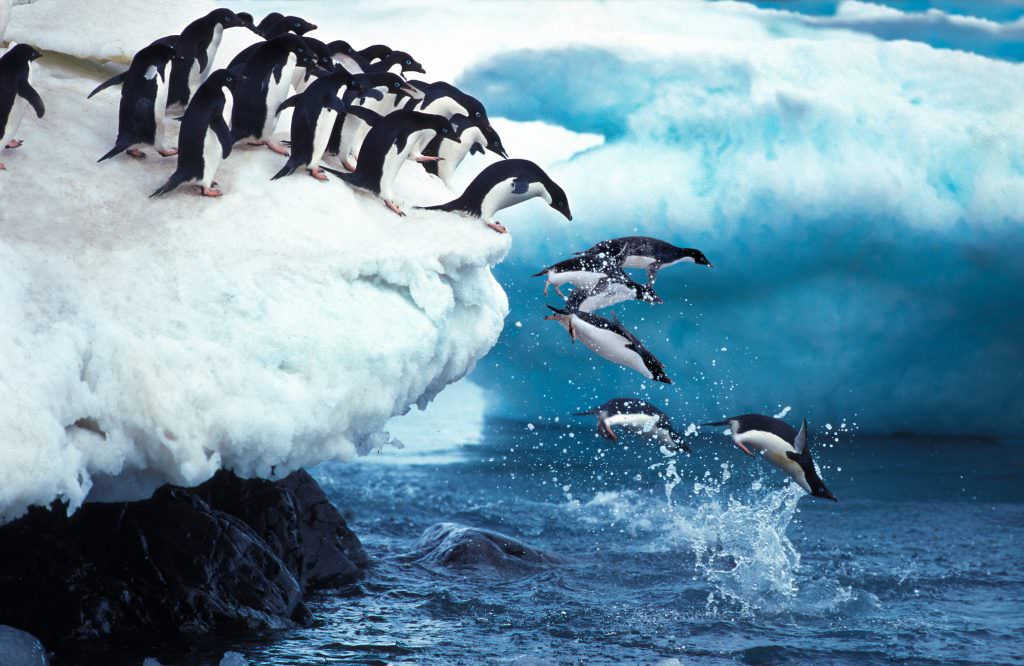
Many first-time visitors arrive with a clear cast of characters in mind. Penguins on the ice. A humpback lifting its flukes. A leopard seal hauled out and watchful. What rarely makes the list is the shrimp-like creature swarming in the water below, and that is understandable, because krill is easy to overlook and hard to see well from a ship. But naturalists working in these waters treat it as the single most important animal in the system, the hinge on which everything else turns. Ask one what they would most want a guest to understand, and the answer is often the krill rather than the whales. A voyage read through that lens changes shape. A raft of feeding penguins reads as evidence: the krill are here, in numbers, right now.
The reason krill matters so much is structural. It sits almost at the base of the food web, turning the ocean’s tiny drifting plants into a package large enough for a whale to bother with. Few other animals do that job at that scale in the Southern Ocean, which is why so many predators have arranged their lives around this one prey. When a naturalist points to krill, they are really pointing at the plumbing that makes polar wildlife-watching possible in the first place.
Numbers that are hard to hold in the head
The quantities involved are genuinely difficult to picture. Scientists are careful with the total, and so should anyone be who repeats it, because the estimates vary widely and depend heavily on method. One body of work puts the standing stock somewhere in the range of 60 to 420 million tonnes. Another arrives at 100 to 500 million tonnes and offers a comparison that tends to stay with people: a mass in that band is roughly comparable to the combined weight of every human being alive. That comparison is best read as exactly what it is, an attributed way of grasping scale rather than a precise fact, but it does its work. There is, at any moment, an amount of this one small animal that rivals all of humanity by weight.
The way krill gathers is just as striking. It forms some of the largest aggregations of any animal on Earth, dense swarms that have been documented covering areas of around 100 square kilometres and holding on the order of two million tonnes of krill in a single mass, with local densities reaching thousands of individuals in a single cubic metre of seawater. A swarm on that scale is why a stretch of ocean that looked empty in the morning can be thick with whales by afternoon. The food arrived.
Not evenly spread, and not staying put
Krill is not scattered evenly around the continent. Around seventy per cent of Antarctic krill is found in the Atlantic sector of the Southern Ocean, the waters that take in the Antarctic Peninsula, the Scotia Sea and the sub-Antarctic islands. This single fact quietly explains a great deal about where the wildlife concentrates and, in turn, where expedition voyages tend to go. The richness of the Peninsula and its surrounding islands is not an accident of scenery; it follows the krill.
That distribution is also shifting. Over recent decades the krill population in the south-west Atlantic sector has contracted southward by roughly 440 kilometres, a change researchers link to warming and to shifts in sea ice. This is a regional pattern rather than a circumpolar one, and it should be described as such, without stretching it into a larger claim than the science supports. But it matters, because krill and ice are bound together. Young krill graze the algae that grows on the underside of sea ice, and the animal’s life cycle is tied to winter ice and to the spring phytoplankton blooms that follow. For the youngest krill, winter ice appears to serve more as shelter than as a larder. Change the ice and you change the nursery.
The animal itself is tougher than its size suggests. When food runs short, krill can actually shrink its body, and in the laboratory individuals have survived more than two hundred days without eating. It lives not for a single season but for several years, up to about a decade, riding out the long polar winters that would finish most creatures of its size.
A small animal doing a large job
Krill also moves carbon. As it feeds near the surface and produces fast-sinking faecal pellets, it carries carbon down into the deep ocean. The temptation is to dress this up into a grand daily migration pump, but recent work is more measured, pointing to the sinking of those pellets, rather than the animals’ vertical movement, as the main pathway. It is a real contribution to how the ocean stores carbon, described plainly and no further.
Because so much depends on krill, the fishery that targets it is watched closely. It has been managed since 1980 by an international commission that sets precautionary catch limits, and actual catches remain a small fraction, under about one per cent, of the estimated biomass. That restraint is deliberate. Krill is the load-bearing wall of the whole ecosystem, and it is managed as one.
What stays with you
Everything a visitor hopes to see in Antarctic waters rests on a crustacean the length of a finger that spends its life being eaten. The whales lunging through a bait ball, the penguins porpoising back to a colony, the seals fat enough to sleep through a squall, none of it holds up without the small animal underneath. So the single image worth carrying south is a plain one. When the sea seems suddenly full of life, it is because, just out of sight, it is full of krill.