The explorers, their endings, and the places you can still reach
The heroic age: Shackleton, Scott, Amundsen, and where you can still stand today
Discover AntarcticaEarly on a still morning at Grytviken, on the northern coast of South Georgia, the light comes in low across the water and catches the white paint of a small church. A short walk from the shoreline, past the rusting tanks of a whaling station that closed in the 1960s, a low fence encloses a cemetery. Among the graves of Norwegian whalers stands a tall, rough headstone of grey granite. Fur seals doze in the tussock nearby, unbothered. This is where Ernest Shackleton lies, and a traveller can stand at the foot of the grave and read the name.
That surprises many people. The heroic age of Antarctic exploration is one of the best-known chapters in the history of the far south, yet a good deal of what we carry in our heads about it is slightly out of place. Shackleton is not buried in Antarctica at all. He died at South Georgia in January 1922, and he was buried at Grytviken, on an island of tussock, glaciers and old whaling stations that sits well north of the continent itself. The story is not only something to read. Much of the ground on which it happened is still there, and some of it can be reached.
Three men, one pole, three endings
The period historians call the Heroic Age of Antarctic Exploration runs roughly from the late 1890s to the early 1920s, often marked as ending with Shackleton’s death. Its most retold episode is the race for the South Pole, and the outline is quickly told, before we turn to the places where it all happened.
Roald Amundsen got there first. His party of five, travelling from a base called Framheim at the Bay of Whales and arriving by dog sledge, reached the South Pole on 14 December 1911. They left a tent and a letter behind for the man they knew was coming. Robert Falcon Scott and his companions reached the same spot on 17 January 1912, about thirty-four days later, and found the tent waiting. The return journey killed them. Edgar Evans died in February. Lawrence Oates, lamed and slowing the others, walked out into a blizzard in the middle of March. Scott, Edward Wilson and Henry Bowers died at the end of March, in a tent that a search party found that November.
Shackleton’s part of the story is different in shape, and it is the one that has fixed itself most firmly in the popular imagination. His Endurance expedition set out in 1914 not to reach the pole but to cross the continent. The ship never landed its crossing party. Beset in the pack ice of the Weddell Sea, crushed, it sank in November 1915. What followed is the part people tend to remember: the escape across the ice, the open-boat crossing of about 1,300 kilometres to South Georgia in the James Caird, the traverse of the island on foot to reach help, and the eventual rescue of every man left waiting on Elephant Island. The whole Endurance party survived.
It is tempting to end the sentence there, but it would not be true of the expedition as a whole. Shackleton’s separate Ross Sea Party, working on the other side of the continent to lay supply depots, lost three of its men. The heroic age was heroic in part because it was genuinely dangerous, and the danger was not evenly distributed.
Where the story is buried, and where it still stands
Here the geography matters, and it is where most travellers’ mental map needs a small correction. The graves and the accessible relics are not in the same place as the great expedition huts.
Grytviken, where the morning began, is the reachable heart of the Shackleton story. It was established as a whaling station in 1904 and worked until the 1960s. Today a small museum occupies part of the site, a Norwegian-style church erected in 1913 still stands, and the grave lies a short walk away in the cemetery. Ships that cruise South Georgia can call here, and visitors do stand at the headstone. As for the Endurance itself, the wreck was located in 2022, lying about 3,000 metres deep in the Weddell Sea. It is a protected historic site and cannot be visited, which sets a quiet limit on how close anyone can get to it.
On the Antarctic Peninsula, the side of Antarctica that most expedition voyages reach, the tangible link to this era is Port Lockroy. It is a former British base on a tiny island, now run as a living museum and a working post office by a heritage trust. Travellers know it, fondly, as the Penguin Post Office, and posting a card from it is one of the small pleasures of a Peninsula voyage.
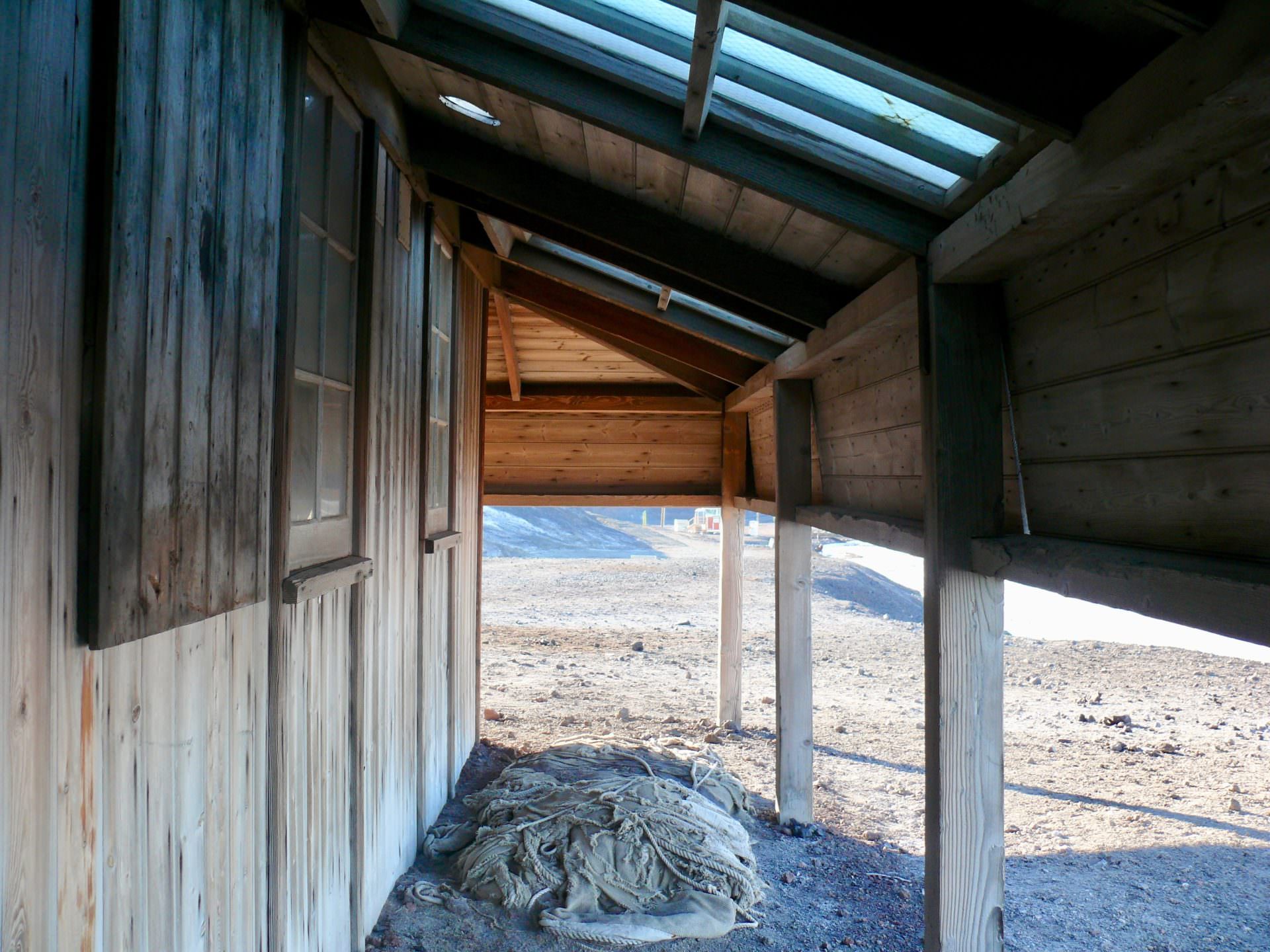
The most evocative structures of all, though, are the ones fewest people see. The huts built by Scott and Shackleton for their own expeditions are not on the Peninsula. They are on the Ross Sea side of the continent, the far side, reached only on long voyages out of New Zealand or Hobart in a short summer season through heavy ice. Scott’s hut at Cape Evans, built in 1911, still stands. So do his earlier Discovery hut at Hut Point and Shackleton’s hut at Cape Royds. A heritage trust cares for them, and they have been preserved almost exactly as they were left, down to the tins on the shelves. Because they lie where they do, very few travellers ever walk through their doors. Where entry is possible, the sites are strictly protected: nothing may be damaged or removed, and only a few people are allowed inside at once.
Standing there is not the same as reading about it
A book can carry the facts of the heroic age faithfully and completely, and many good ones do. What a book can’t give is the feeling of standing at the graveside itself, or the scale of the grey water the James Caird crossed. Seeing these places in person is a different thing from reading about them, and different again in a small group with a historian aboard who can stand at the graveside and fill in what the headstone leaves out.
For a traveller drawn to the human story rather than only the scenery, that difference counts. Voyages to South Georgia and the Antarctic Peninsula that carry expert lecturers make these sites part of the itinerary, and the far Ross Sea huts, harder won, are reached on a smaller number of longer expeditions each season. If the heroic age is a chapter you have long wanted to stand inside rather than simply read, it may be worth looking into which routes call at these places, and when their short windows open, well before you plan to travel.